3 Scientific Facts That Say You Can Stop Taking Advice From Bodybuilders
Bodybuilding advice is built for the stage. These three findings show why it doesn’t transfer to a man who wants abs and a full calendar.
 Sara Scott· Editor, Executive Abs · Oct 20, 2026
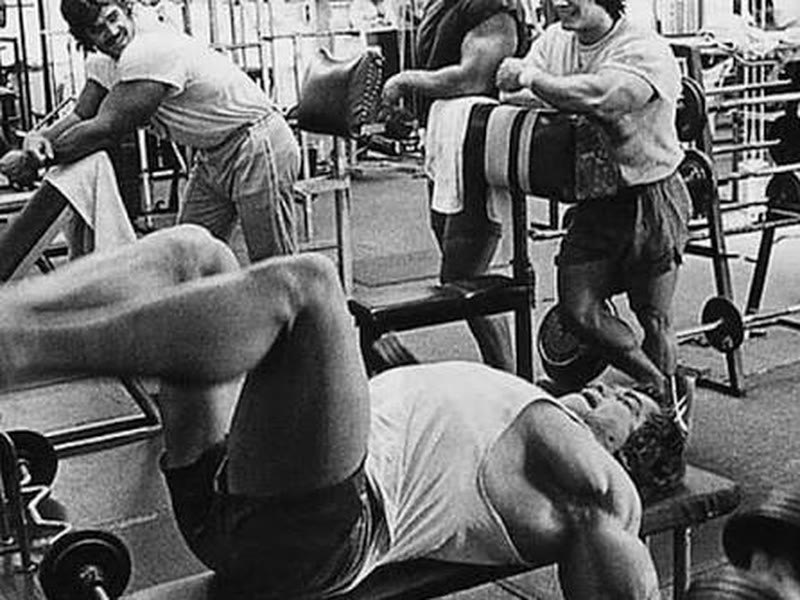
Bodybuilders are very good at what they do. They’ve spent decades refining methods for one specific goal: building as much muscle as possible and showing it off on a stage. The problem isn’t the advice itself. It’s that almost everyone else has been handed that advice, whatever their goal.
If you’re a busy man who wants to be lean, strong and to see your abs, the research points somewhere else. Here are three findings that explain why.
You don’t need bodybuilding volume to get strong
The classic bodybuilding week trains each muscle group on its own day, with set after set to push growth. That makes sense if size is the goal. It isn’t necessary if strength and health are.
In a 2019 trial, trained men did one, three or five sets per exercise for eight weeks. The higher-volume groups built more muscle size, but strength gains were similar across all three. The one-set group trained in sessions of about 13 minutes, three times a week.1
Five times the sets, similar strength
Eight weeks of training in trained men. Muscle size grew with volume; strength gains did not differ meaningfully.
Source: Schoenfeld et al., Medicine & Science in Sports & Exercise, 2019. n = 34 trained men.
How often you train matters less than many programmes suggest, too. A meta-analysis of 25 studies found that when total weekly work was the same, training frequency made no significant difference to muscle growth.2 A review of time-efficient training concluded that a few multi-joint lifts, such as a push, a pull and a leg movement, done consistently cover most of what a busy adult needs.3
The health research agrees. The biggest drop in mortality risk from strength training shows up at about 30–60 minutes a week.4 That’s two or three short sessions, not a six-day split.
“The goal is never to bench a Volkswagen. The goal is functional strength in the pocket.”Ryan Engel · Founder, Executive Abs
Abs are revealed outside the gym, not built in it
Most men already have abdominal muscles. What hides them is the layer of fat on top. You can’t crunch that layer away. In a six-week trial, adults did seven abdominal exercises five days a week. Their abdominal endurance improved, but there was no significant change in belly fat, waist size or body fat.5
Training harder doesn’t burn off as much as you’d think, either. When researchers measured daily energy use in 332 adults with a precise lab method, total energy burned rose with activity at first and then plateaued. The body adapts and partly compensates at higher activity levels.6 Everyday movement outside workouts matters more than most people assume. In a classic overfeeding study, changes in non-exercise movement (walking, standing, fidgeting) explained most of why some people gained far less fat than others.7
Sleep matters more than almost anyone expects. In a small but striking trial, people on the same diet lost 55% less fat when they slept 5.5 hours instead of 8.5, and lost more lean tissue instead.8
Same diet, less sleep, less fat lost
Two weeks of calorie restriction with 8.5 vs 5.5 hours in bed
Source: Nedeltcheva et al., Annals of Internal Medicine, 2010. Small crossover trial, n = 10.
Protein helps protect muscle while you lean out. In one trial, young men in a steep calorie deficit who ate a higher-protein diet gained lean mass and lost more fat than those on a moderate-protein diet.9 The subjects were young, so the exact numbers may not carry over, but the direction is consistent with wider research.
Put together, these findings change where the effort should go. Eating, sleep, daily movement and stress management do most of the work of revealing abs. The gym session is important, but it’s a smaller lever than bodybuilding culture suggests.

The body men chase isn’t the one others prefer
Researchers have studied this for decades, and they keep finding a gap between what men think looks best and what women actually find attractive.
In a study of college men in the US, France and Austria, the men picked an ideal body about 28 lb more muscular than their own. They believed women wanted about 30 lb more muscle than they had. When women were asked in a pilot study, they chose an ordinary male body without added muscle.10
A series of six studies from UCLA found the same pattern from another angle. Women rated muscular men as attractive, but the highest ratings went to moderately muscular builds, not the bulkiest options. Women also rated the most muscular men as more dominant and less likely to commit.11
The most attractive build sits in the middle
Women rated moderately muscular builds higher than the brawniest options.
Schematic illustration based on Frederick & Haselton, Personality and Social Psychology Bulletin, 2007. Not the study’s original images.
Strength still matters. When women rated photos of ordinary college men, how strong a man looked explained most of his body’s attractiveness, and leanness added to it.12 That study didn’t include bodybuilders, so it can’t tell us where the ceiling is. Taken together, the research describes a body that is strong, lean and proportioned, not one built for maximum size.
That’s the body most men actually want for themselves when they stop to think about it: one that looks good in a suit, on the beach and with the shirt off. Bodybuilding is aimed at a stage and a judging panel. Your goal is aimed at real life.
Bodybuilding is aimed at a stage and a judging panel. Your goal is aimed at real life.
So who should you listen to?
None of this is a knock on bodybuilders. Their methods work brilliantly for their sport. The point is that a goal decides a method. If your goal is different, the method should be too.
For a busy man who wants abs, the evidence points to a different set of priorities: fat loss driven by food, sleep and daily movement; a few short, efficient strength sessions; and a physique aimed at lean and proportioned rather than as big as possible.
“Follow the methods of the coaches you want to look like. Do you want to stand on a stage, or would you rather be lean and have abs?”Ryan Engel · Founder, Executive Abs
Want the full health picture? Read The Science of Lean: Why the Lean Physique Beats the Bodybuilder Build.
One-to-one coaching built around your calendar, your travel and your starting point. Three to four sessions a week, max. For busy executives, founders and CEOs only.
See the method →References
- Schoenfeld BJ, et al. Resistance training volume enhances muscle hypertrophy but not strength in trained men. Med Sci Sports Exerc. 2019;51:94–103. pubmed.ncbi.nlm.nih.gov/30153194
- Schoenfeld BJ, Grgic J, Krieger J. How many times per week should a muscle be trained to maximize muscle hypertrophy? A systematic review and meta-analysis. J Sports Sci. 2019;37:1286–95. pubmed.ncbi.nlm.nih.gov/30558493
- Iversen VM, et al. No time to lift? Designing time-efficient training programs for strength and hypertrophy: a narrative review. Sports Med. 2021;51:2079–95. pubmed.ncbi.nlm.nih.gov/34125411
- Momma H, et al. Muscle-strengthening activities are associated with lower risk and mortality in major non-communicable diseases. Br J Sports Med. 2022;56:755–63. pubmed.ncbi.nlm.nih.gov/35228201
- Vispute SS, et al. The effect of abdominal exercise on abdominal fat. J Strength Cond Res. 2011;25:2559–64. pubmed.ncbi.nlm.nih.gov/21804427
- Pontzer H, et al. Constrained total energy expenditure and metabolic adaptation to physical activity in adult humans. Curr Biol. 2016;26:410–7. pubmed.ncbi.nlm.nih.gov/26832439
- Levine JA, Eberhardt NL, Jensen MD. Role of nonexercise activity thermogenesis in resistance to fat gain in humans. Science. 1999;283:212–4. pubmed.ncbi.nlm.nih.gov/9880251
- Nedeltcheva AV, et al. Insufficient sleep undermines dietary efforts to reduce adiposity. Ann Intern Med. 2010;153:435–41. pubmed.ncbi.nlm.nih.gov/20921542
- Longland TM, et al. Higher compared with lower dietary protein during an energy deficit combined with intense exercise promotes greater lean mass gain and fat mass loss. Am J Clin Nutr. 2016;103:738–46. pubmed.ncbi.nlm.nih.gov/26817506
- Pope HG Jr, et al. Body image perception among men in three countries. Am J Psychiatry. 2000;157:1297–1301. doi.org/10.1176/appi.ajp.157.8.1297
- Frederick DA, Haselton MG. Why is muscularity sexy? Tests of the fitness indicator hypothesis. Pers Soc Psychol Bull. 2007;33:1167–83. doi.org/10.1177/0146167207303022
- Sell A, Lukaszewski AW, Townsley M. Cues of upper body strength account for most of the variance in men’s bodily attractiveness. Proc R Soc B. 2017;284:20171819. pmc.ncbi.nlm.nih.gov/articles/PMC5745404
This article is for general information and is not medical advice. Speak to your doctor before making major changes to diet or training. Observational studies show associations, not proof of cause.