The Identity Crisis of the Gym Goer: Don’t Fall for It
Who you think you are decides what you do. What felt like achievement at 25 can quietly cost you at 45. Here’s the choice in front of you.
 Sara Scott· Editor, Executive Abs · Oct 15, 2026
At 25, the gym can feel like the best thing in your life. It’s measurable, it rewards effort and it gives you something to be proud of. You become "a gym guy". For a while, that identity works beautifully.
Then life gets bigger. A company, a team, a family, a board, a calendar that never empties. The identity that once felt like achievement starts to feel like an obligation. Many men keep going anyway, because changing what you do means changing who you think you are.
This article is about that moment, and the choice that comes with it.
Who you think you are decides what you do
Psychologists have a name for this: identity-based motivation. Daphna Oyserman’s research shows that people act in ways that fit the identity that feels active in the moment. When an action feels like "something people like me do", it feels easier and more natural. When it doesn’t fit, it feels like a struggle.1
A famous set of experiments showed how strong this effect can be. Before two US elections, researchers asked people either how important it was "to vote" or how important it was "to be a voter". The only difference was framing the action as part of who you are. Turnout was 95.5% versus 81.8% in one election and 89.9% versus 79.0% in the other.2
Framing an action as identity changed behaviour
Voter turnout after reading "be a voter" (identity) vs "to vote" (action)
Source: Bryan, Walton, Rogers & Dweck, PNAS, 2011. Experiments 2 (n = 88) and 3 (n = 214).
And what you do decides who you become
The loop runs the other way too. Much of daily life runs on autopilot. Research by psychologist Wendy Wood suggests that around 43% of what we do each day is done out of habit, often in the same place and at the same time.3 Repeated long enough, an action stops feeling like a choice. In one study of new habits, it took a median of 66 days for a behaviour to become automatic, with a range from 18 to 254 days.4
The identity loop
Identity shapes choices, choices become habits and habits become evidence of who you are.
Concept based on Oyserman, Journal of Consumer Psychology, 2009, and habit research by Wood and Lally.
That’s why the gym identity can be so sticky. Years of six-day weeks don’t just build a routine. They build a sense of self. Sport psychologists have studied this with athletes: a strong athletic identity brings real benefits, but it can become a weak point when life changes and the role no longer fits.5
What made sense at 25 doesn’t always make sense at 45
In your twenties, hours in the gym are cheap. You recover quickly, your calendar is flexible and your career hasn’t reached the point where every hour has a clear price. Getting bigger is a tangible win.
By your forties and fifties, the maths has changed. Time is your scarcest asset. Recovery is slower. Testosterone tends to decline year by year.6 And what you need from your body has shifted: energy for long days, a lean frame that looks sharp in a suit, joints that keep working, and a heart that will carry you for decades.
“After I crossed the 40 line, my metabolism was no longer running at the same rate. I was the busiest I’d ever been, with two major company acquisitions. But I knew I could never let my lean body go. I needed to be operational. I needed to be mentally strong.”Ryan Engel · Founder, Executive Abs
At the far end of the gym identity, the pressure to keep getting bigger can push some men towards performance-enhancing drugs. An Endocrine Society statement notes that most users of these drugs are not competitive athletes but recreational weightlifters chasing a look. It links their use to cardiovascular, psychiatric and hormonal problems.7 Researchers have even described a condition, muscle dysmorphia, in which people feel too small no matter how muscular they become.8 Most gym goers never go near either. But it shows where an identity built on size can lead if it is never questioned.

The choice in front of you
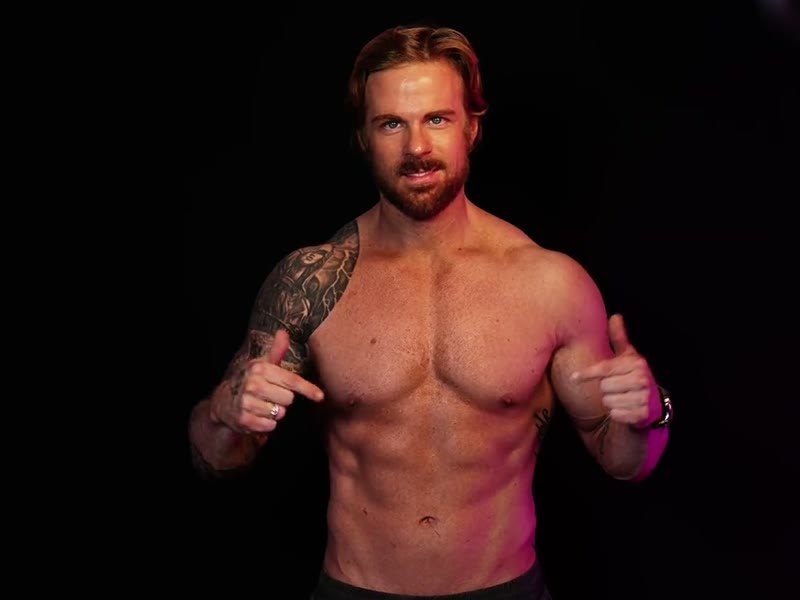
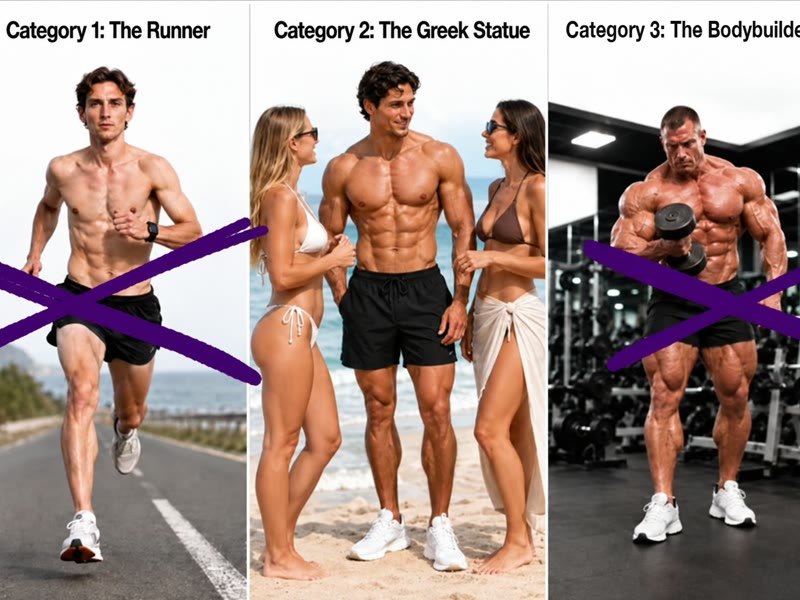
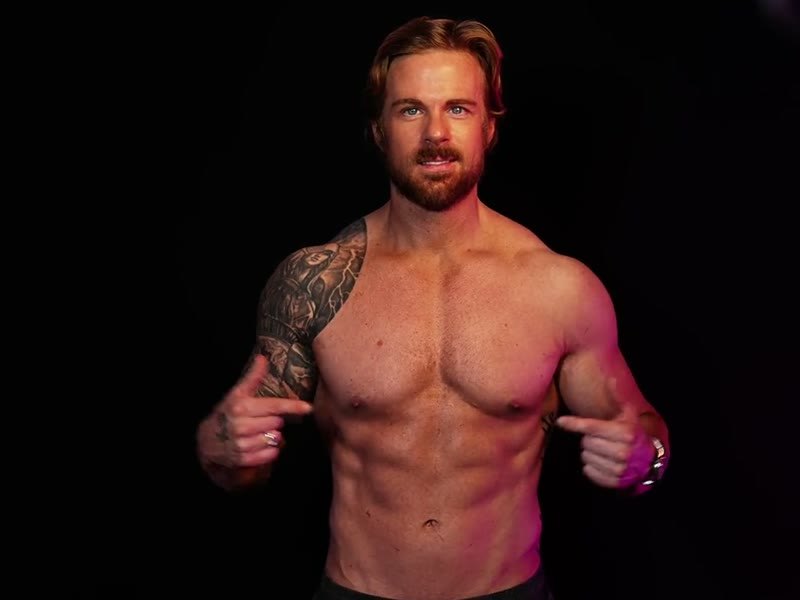
So here is the choice. You can be the man who looks like he lives in the gym, with a body built around training volume and, for some, around what they put into their bodies to keep growing. Or you can be the man who looks like he has important things to attend to and still stays lean, with visible abs, by the most efficient route there is.
The choice is yours. But here’s our advice, laid out on every comparison that matters.
Two identities, compared
| "The gym guy" | The Executive Body | |
|---|---|---|
| Attractiveness | Built for maximum size. Women in research rated the brawniest builds below moderately muscular ones.9 | Lean, proportioned and defined: the moderately muscular build women rated highest.9 |
| Health | Strong, but often with bulking phases that add waist fat; drug risks at the extreme end.7 | Small waist, real strength and aerobic fitness: the combination linked to the lowest mortality.10 |
| Time | Often five or six sessions a week, plus prep and recovery | Three to four focused sessions a week, max |
| Wealth | Hours and identity tied up in the gym | Hours back for work and family; the look and energy that support a career.11,12 |
| Identity | "I’m a gym guy" | "I’m a leader who stays lean" |
Yes, wealth
It sounds like a stretch, but it isn’t. Economists have long found that appearance pays. In a well-known analysis, plainer-looking workers earned 5–10% less than average-looking ones, with a smaller premium for good looks.11 A working paper on S&P 1500 companies found that firms led by CEOs who had finished a marathon were valued about 5% higher, and the gap was bigger in high-stress situations.12 That’s a correlation, not proof, but it fits what most leaders already sense: fitness signals discipline, energy and control.
Then there’s time. Moving from a six-day routine to three or four efficient sessions frees up hours every week. Those hours go to the work, the people and the decisions that actually build your wealth. When your identity isn’t tied to the gym, the gym becomes a tool, not a second job.
When your identity isn’t tied to the gym, the gym becomes a tool, not a second job.
How to make the switch
Identity change starts with a sentence. Instead of "I’m trying to get in shape", try "I’m someone who stays lean." Then give yourself evidence: a few weeks of consistent, efficient sessions, better sleep and meals that keep you full. The research on habits says it takes time, often a couple of months, before it feels automatic. After that, it’s just who you are.
“An executive body means when you walk into the room, you immediately call attention. You’re not only at the top of your career field. You’re at the top of your discipline game.”Ryan Engel · Founder, Executive Abs
One-to-one coaching built around your calendar, your travel and your starting point. Three to four sessions a week, max. For busy executives, founders and CEOs only.
See the method →References
- Oyserman D. Identity-based motivation: implications for action-readiness, procedural-readiness, and consumer behavior. J Consum Psychol. 2009;19:250–60. deepblue.lib.umich.edu
- Bryan CJ, Walton GM, Rogers T, Dweck CS. Motivating voter turnout by invoking the self. Proc Natl Acad Sci USA. 2011;108:12653–6. pmc.ncbi.nlm.nih.gov/articles/PMC3150938
- Wood W, Quinn JM, Kashy DA. Habits in everyday life: thought, emotion, and action. J Pers Soc Psychol. 2002;83:1281–97; and American Psychological Association, Speaking of Psychology: behavioral habits. apa.org
- Lally P, van Jaarsveld CHM, Potts HWW, Wardle J. How are habits formed: modelling habit formation in the real world. Eur J Soc Psychol. 2010;40:998–1009. doi.org/10.1002/ejsp.674
- Brewer BW, Van Raalte JL, Linder DE. Athletic identity: Hercules’ muscles or Achilles heel? Int J Sport Psychol. 1993;24:237–54.
- Feldman HA, et al. Age trends in the level of serum testosterone and other hormones in middle-aged men. J Clin Endocrinol Metab. 2002;87:589–98. pubmed.ncbi.nlm.nih.gov/11836290
- Pope HG Jr, et al. Adverse health consequences of performance-enhancing drugs: an Endocrine Society scientific statement. Endocr Rev. 2014;35:341–75. pubmed.ncbi.nlm.nih.gov/24423981
- Pope HG Jr, Gruber AJ, Choi P, Olivardia R, Phillips KA. Muscle dysmorphia: an underrecognized form of body dysmorphic disorder. Psychosomatics. 1997;38:548–57. doi.org/10.1016/S0033-3182(97)71400-2
- Frederick DA, Haselton MG. Why is muscularity sexy? Tests of the fitness indicator hypothesis. Pers Soc Psychol Bull. 2007;33:1167–83. doi.org/10.1177/0146167207303022
- Zhao M, et al. Recommended physical activity and all cause and cause specific mortality in US adults. BMJ. 2020;370:m2031. pubmed.ncbi.nlm.nih.gov/32611588
- Hamermesh DS, Biddle JE. Beauty and the labor market. Am Econ Rev. 1994;84:1174–94. nber.org/papers/w4518
- Limbach P, Sonnenburg F. Does CEO fitness matter? CFR Working Paper 14-12, University of Cologne (revised 2015). Working paper; not peer-reviewed. ideas.repec.org
This article is for general information and is not medical advice. Speak to your doctor before making major changes to diet or training. Observational studies show associations, not proof of cause.