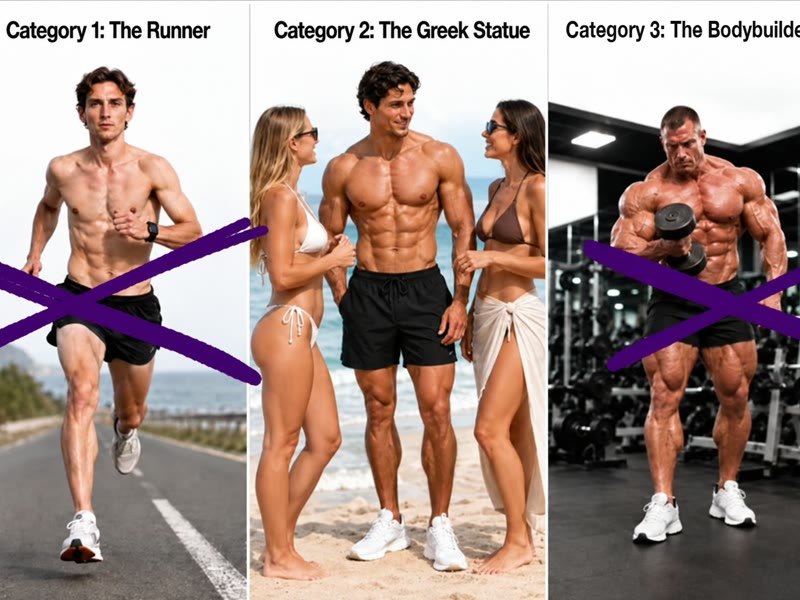
How Is the Abs-First Approach Different?
Most fitness advice is a copy of a copy of bodybuilding. It isn’t anyone’s fault, and it isn’t your only option.
 Sara Scott· Editor, Executive Abs · Oct 13, 2026
If you’ve tried to get lean before and it didn’t stick, here’s something worth hearing: it probably wasn’t you. Most of the advice you were given was built for someone else, a younger man with a different goal and a lot more free time.
That’s not because anyone in the fitness industry is trying to mislead you. It’s because almost everyone in it is following the same playbook, and that playbook came from bodybuilding.
A copy of a copy
Look at where most fitness advice comes from and a pattern appears. Gym culture is largely a young culture. The most popular programmes, apps and online coaches are aimed at men in their twenties with time to train five or six days a week. Many of the older voices in the industry came up through bodybuilding or physique competition, and their programmes reflect it.
Each generation learns from the last. Magazines learned from the stage. Gyms learned from the magazines. Online coaches learned from the gyms. Today’s apps learn from the online coaches. Somewhere along the way the original goal, maximum muscle for a judging panel, got baked into advice for everyone.
How bodybuilding became the default
Each layer learns from the one before it. The original goal travels down the chain.
The people passing this advice along aren’t doing anything wrong. They’re teaching what they were taught, and it works for the goal it was designed for. They just haven’t had a reason to question whether it fits a 45-year-old founder who wants abs and has four free hours a week. The whole market moves together, like a ball and chain that nobody notices because everyone is wearing it.

“Six days of training per week, and the mid-20-something YouTuber that’s giving you advice, is not going to fit your lifestyle.”Ryan Engel · Founder, Executive Abs
Take the pressure off
If the standard advice never fit your life, falling off it isn’t a failure of discipline. You were running someone else’s race. Most successful executives are extraordinarily disciplined. The problem is usually the plan, not the person.
Abs-first starts from a different question. Not "how do bodybuilders train?" but "what is the most direct route from where you are to lean with visible abs, given your actual life?"
Us vs them, side by side
| The inherited default | Abs-first | |
|---|---|---|
| Starting question | How do bodybuilders train? | What’s the most direct route to lean and abs for this person? |
| End goal | More size, bigger lifts | Lean, defined, agile: the Executive Body |
| Training week | Body-part splits across 5–6 days | 3–4 focused sessions a week, max |
| Core | A few sets at the end, if there’s time | The centre of the plan, for definition and mobility |
| Nutrition | Bulk, then cut; often hungry | Activate the metabolism without hunger or cravings |
| Joints and recovery | Heavier loads, more wear | Joint-friendly strength that lasts decades |
| Built for | Twenty-somethings with free time | Busy executives, founders and CEOs |
What the evidence supports
The abs-first approach isn’t a trend. It lines up with what research shows about how lean, healthy bodies are actually built.
- Fewer, better sessions. When total weekly work is the same, training frequency makes little difference to muscle growth,1 and strength gains can be similar with a fraction of the volume.2
- A modest dose is enough for health. The biggest drop in mortality risk from strength training appears at around 30–60 minutes a week.3
- Fat loss happens mostly outside the gym. Ab exercises alone don’t shrink belly fat,4 while sleep can change how much fat you lose on the same diet.5
- The target is the right one. Lean and proportioned is the build women in research rate most attractive,6 and a small waist is one of the strongest markers of long-term health.7

What a week looks like
Two very different weeks
An illustrative body-part split vs an abs-first week
| Mon | Tue | Wed | Thu | Fri | Sat | Sun | |
|---|---|---|---|---|---|---|---|
| Typical split | Chest | Back | Legs | Shoulders | Arms | Legs or "weak points" | Rest |
| Abs-first | Strength + core | Walk | Strength + core | Walk | Strength + core | Optional session | Rest |
Illustrative only. Real abs-first plans are tailored to each client’s schedule and starting point.
The difference isn’t just the number of days. Each abs-first session is built around compound strength and core work that improves definition, posture and mobility. Food is set up so you stay full and sharp through the day. The whole plan is designed around travel, business dinners and a calendar that doesn’t slow down.
“I’m not asking you to take a fitness path right now. I’m asking you to take a direct path to abs.”Ryan Engel · Founder, Executive Abs
The bottom line
The fitness market isn’t against you. It’s just following itself. Once you see that most advice is a copy of a copy of bodybuilding, you’re free to step off that path and take the direct one.
And because we’re confident in it, we put the risk on us: we get you abs, or you don’t pay.
One-to-one coaching built around your calendar, your travel and your starting point. Three to four sessions a week, max. For busy executives, founders and CEOs only.
See the method →References
- Schoenfeld BJ, Grgic J, Krieger J. How many times per week should a muscle be trained to maximize muscle hypertrophy? J Sports Sci. 2019;37:1286–95. pubmed.ncbi.nlm.nih.gov/30558493
- Schoenfeld BJ, et al. Resistance training volume enhances muscle hypertrophy but not strength in trained men. Med Sci Sports Exerc. 2019;51:94–103. pubmed.ncbi.nlm.nih.gov/30153194
- Momma H, et al. Muscle-strengthening activities are associated with lower risk and mortality in major non-communicable diseases. Br J Sports Med. 2022;56:755–63. pubmed.ncbi.nlm.nih.gov/35228201
- Vispute SS, et al. The effect of abdominal exercise on abdominal fat. J Strength Cond Res. 2011;25:2559–64. pubmed.ncbi.nlm.nih.gov/21804427
- Nedeltcheva AV, et al. Insufficient sleep undermines dietary efforts to reduce adiposity. Ann Intern Med. 2010;153:435–41. pubmed.ncbi.nlm.nih.gov/20921542
- Frederick DA, Haselton MG. Why is muscularity sexy? Pers Soc Psychol Bull. 2007;33:1167–83. doi.org/10.1177/0146167207303022
- Pischon T, et al. General and abdominal adiposity and risk of death in Europe. N Engl J Med. 2008;359:2105–20. pubmed.ncbi.nlm.nih.gov/19005195
This article is for general information and is not medical advice. Speak to your doctor before making major changes to diet or training. Observational studies show associations, not proof of cause.