Why Almost All Fitness Advice Comes From Bodybuilding
From Sandow to Arnold to your Instagram feed: how one sport ended up writing the rulebook for everyone who wants to get in shape.
 Sara Scott· Editor, Executive Abs · Oct 17, 2026
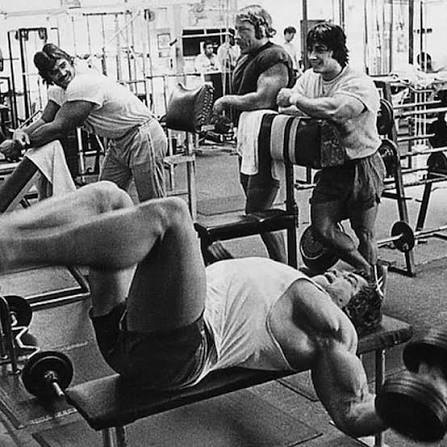
Walk into almost any gym and you’ll hear the same vocabulary: chest day, leg day, bulking, cutting, chasing the pump. It sounds like the natural language of fitness. It isn’t. It’s the language of one sport, bodybuilding, and the story of how it became everyone’s default is worth knowing.
That story has a hero, and we’re fans. Arnold Schwarzenegger did more than anyone to make strength training part of everyday life. Millions of people picked up a weight because of him. But the methods that came along with that boom were built for a very specific goal. Understanding where they came from makes it easier to decide whether they fit yours.
From strongmen to a stage
Modern bodybuilding is usually traced to Eugen Sandow, a Prussian-born strongman who became a star of the late 19th century’s "physical culture" movement. In September 1901 he staged the "Great Competition" at London’s Royal Albert Hall, which Guinness World Records lists as the first major bodybuilding contest. Arthur Conan Doyle was one of the judges.1
The idea was new: judge a body not by what it could do, but by how it looked. Over the next century, that idea grew into a sport, an industry and, eventually, a culture.
How one sport became the default
Key moments in bodybuilding’s rise into mainstream fitness
- 1901Sandow’s Great CompetitionRoyal Albert Hall, London. The first major bodybuilding contest.
- 1934Muscle Beach opensEquipment installed south of the Santa Monica Pier becomes a magnet for lifters and acrobats.
- 1946The Weiders found the IFBBBen and Joe Weider create the sport’s governing federation in Montreal.
- 1965Mr. Olympia and Gold’s GymThe first Mr. Olympia is held in New York, and Joe Gold opens Gold’s Gym in Venice, California.
- 1970Arnold’s first OlympiaThe first of seven titles (1970–75 and 1980).
- 1977Pumping IronThe documentary takes bodybuilding, and Arnold, to a mainstream audience.
- 1980sMagazines and the gym boomMuscle & Fitness (1980), Flex (1983) and Arnold’s Encyclopedia of Modern Bodybuilding (1985) become training manuals for the public.
- 2000s+Memberships multiplyUS health club membership rises nearly 90% from 1987 to 2000, and reaches 57 million by 2016.
Sources: Guinness World Records; Living New Deal; IFBB and Mr. Olympia records; IHRSA membership data. See references.
Arnold, the ambassador
Arnold arrived in America with a set of titles already behind him and an ambition to match. He won the Mr. Olympia seven times. More importantly for the rest of us, he was charismatic. When Pumping Iron came out in 1977, it showed a world that had seemed niche and odd as fun, disciplined and aspirational. It’s widely credited with helping launch the gym boom that followed.2
Then came the films, the magazines and the books. For a generation of men, Arnold was fitness. His training methods, and those of the bodybuilders around him, became the template.
Joe Weider’s magazines spread that template further. Weider gathered and popularised a set of "Weider Training Principles", including the split routine that trains different body parts on different days.3 Bodybuilders didn’t invent all of these ideas, but they packaged them, named them and sold them to the public. Many are still the backbone of gym programmes today.
“When it comes to getting abs, there’s one thing so many people miss entirely. They take this roundabout bodybuilding method when it’s not necessary.”Ryan Engel · Founder, Executive Abs
The ideal kept getting bigger
As bodybuilding’s influence spread, so did its idea of what a man should look like. Psychiatrists studying male body image measured popular action figures from three decades and scaled them to the size of a real man. The toys had grown steadily more muscular, and many surpassed even the largest real bodybuilders.4
The action-figure arms race
G.I. Joe’s biceps, scaled to a man 5′10″ tall
Source: Pope et al., International Journal of Eating Disorders, 1999; scaled measurements as reported in press coverage of the study.
That’s not a criticism of anyone who grew up wanting to look like Arnold. It shows how strongly one sport’s standards shaped the picture of a "fit" man, often without anyone noticing.

A sport with its own costs
Arnold has always been open about his own era. In 2005 he said he had no regrets about using steroids, which were legal at the time, because "it was something new".5 More recently he has warned young people away from them and said bodybuilding is no longer safe the way it is practised today.6
He has also criticised the sport for drifting towards sheer size at the expense of shape. He has argued that judges reward mass over aesthetics, and he has told competitors to aim for more symmetry and more definition.7 In 2023 he launched a free daily newsletter focused on everyday health and fitness for people of all ages, not competition.8
That’s the most interesting part of the story. The man who did the most to popularise bodybuilding is now one of its most thoughtful critics, and he’s pointing towards proportion, definition and lifelong health.
The man who popularised bodybuilding now points towards proportion, definition and lifelong health.
Why it still matters for you
Bodybuilding methods weren’t designed to be wrong. They were designed for a goal: maximum muscle, judged on a stage, by people who could devote their lives to it. When those methods became everyone’s default, most people inherited a plan built for a different body and a different life.
- Body-part splits spread training across five or six days to maximise volume for each muscle group.
- Bulking and cutting deliberately adds fat to build size, then strips it off for a show.
- The pump is a short-term swelling prized for how it looks, not for health or strength.
None of these is necessary if your goal is a lean, strong body with visible abs. Research on strength and health suggests the biggest benefits come from a modest amount of strength training, around 30–60 minutes a week, alongside aerobic activity, good sleep and smart eating.9
Arnold made strength training mainstream, and we owe him for that. The next step is to keep the parts that serve you and leave the stage-specific parts on the stage.
Read next: How is the abs-first approach different?
One-to-one coaching built around your calendar, your travel and your starting point. Three to four sessions a week, max. For busy executives, founders and CEOs only.
See the method →References
- Guinness World Records. First bodybuilding contest. guinnessworldrecords.com; Arthur Conan Doyle Encyclopedia. Sandow Great Competition. arthur-conan-doyle.com
- Little White Lies. In praise of Pumping Iron. lwlies.com; Living New Deal. Original Muscle Beach, Santa Monica. livingnewdeal.org
- Bodybuilding.com. Remembering Joe Weider: the science of the Weider principles. bodybuilding.com
- Pope HG Jr, Olivardia R, Gruber A, Borowiecki J. Evolving ideals of male body image as seen through action toys. Int J Eat Disord. 1999;26:65–72. onlinelibrary.wiley.com
- ABC News, This Week. Schwarzenegger interview, 2005. abcnews.go.com
- ET Online. Arnold Schwarzenegger candidly addresses past steroid use. 2023. etonline.com
- Bodybuilding.com. Pro bodybuilding has lost its way (Arnold Classic seminar, 2015). bodybuilding.com; Sportskeeda. Arnold on the 2022 Mr. Olympia. sportskeeda.com
- Arnold’s Pump Club. Welcome to the Pump app. arnoldspumpclub.com
- Momma H, et al. Muscle-strengthening activities are associated with lower risk and mortality in major non-communicable diseases. Br J Sports Med. 2022;56:755–63. pubmed.ncbi.nlm.nih.gov/35228201; IHRSA membership data via American Spa, 2017. americanspa.com
This article is for general information and is not medical advice. Speak to your doctor before making major changes to diet or training. Observational studies show associations, not proof of cause.