The Ideal Male Physique: What Troy and the Greek Statues Got Right
Brad Pitt’s Achilles, the Doryphoros and modern attractiveness research all point to the same body: lean, proportioned and powerful, not massive.
 Sara Scott· Editor, Executive Abs · Oct 21, 2026
In 1999, a generation of men watched Brad Pitt take his shirt off in Fight Club and decided that was the goal. Five years later, in Troy, he did it again, a little fuller and a little stronger. Neither body was big. Neither was a bodybuilder’s. And yet those two physiques have probably inspired more men than every bodybuilding stage of the same era combined.
That’s not an accident, and it isn’t just Brad Pitt. The body men most want and the body women rate most attractive turn out to be the same one. It’s the same body Greek sculptors carved in marble 2,500 years ago: lean, proportioned and powerful, not massive.
“Most men don’t want the biggest body. They want the best-looking one.”Ryan Engel · Founder, Executive Abs
Achilles, built for the screen
To play Achilles, Pitt needed to look like the greatest warrior who ever lived. He put it more bluntly: the character was "supposed to be the greatest warrior of all time," so he had to get himself in shape. He quit smoking, which he admitted he still missed, and by the end of filming he had been on the same diet and training plan for about a year.1 He described starting about six months before the shoot, with protein-focused, low-carb meals.2
What that plan built is the interesting part. His trainer has described the focus as the back and arms rather than a big chest, and said Pitt never had trouble leaning out.3 The result was a wide back, broad shoulders, a narrow waist and visible abs: a warrior’s frame, not a stage physique. On screen, he looked like a statue that had come to life.
The goal was a warrior, not a bodybuilder. The result looked like a statue that had come to life.
The standard is 2,500 years old
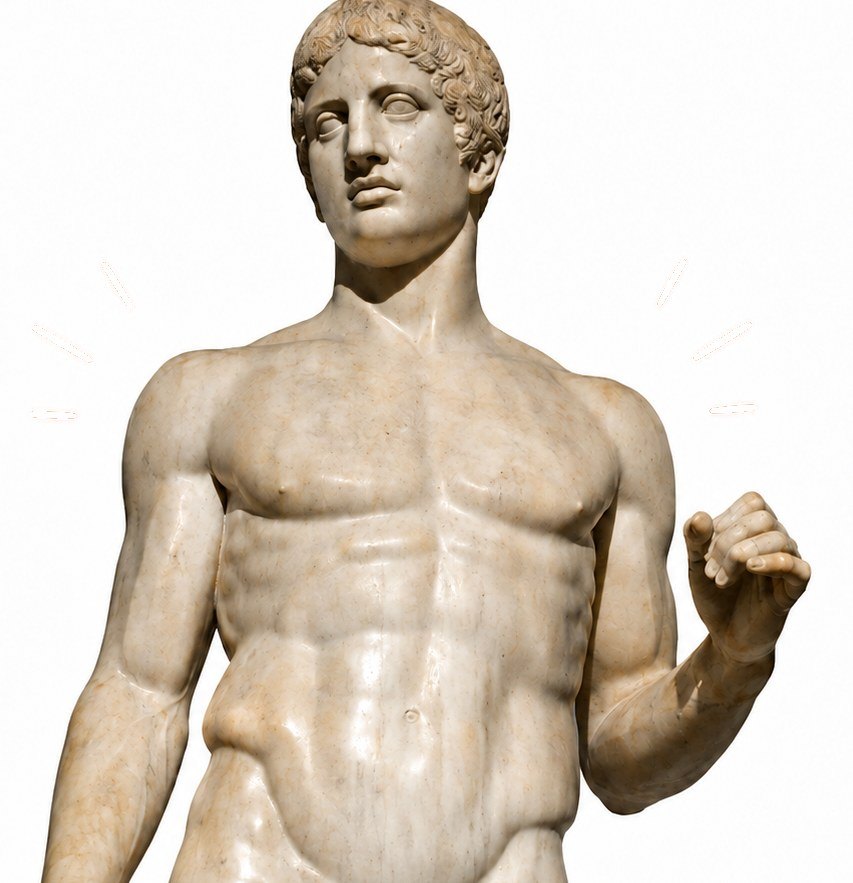
Walk through the classical rooms of any major museum and you’ll see the same body again and again: broad shoulders tapering to a narrow waist, a defined midsection, muscle that looks capable rather than inflated.
The most famous example is the Doryphoros, or Spear-Bearer, by the sculptor Polykleitos, made around 450–440 BCE. The original bronze is lost, but Roman marble copies survive. One of the best known, found at Pompeii, stands in the National Archaeological Museum in Naples. Polykleitos made the statue to illustrate a treatise called the Canon, which set out the ideal proportions of the male body.4
His idea was symmetria: beauty comes from the relationship of every part to every other part. Finger to hand, hand to forearm, forearm to arm, and on through the whole body.4 It wasn’t about any one muscle being as big as possible. It was about how everything fits together.
The Greeks were so devoted to these proportions that the idea has come down to us as the golden ratio of the male body: broad shoulders, a narrow waist, and every part in balance with the rest. The lesson for today is simple. Proportion beats size.
Even bodybuilding started here
The founder of modern bodybuilding agreed. Eugen Sandow, who staged the first major bodybuilding contest in 1901, modelled his own physique on classical Greek statues. That same year, London’s Natural History Museum had a plaster cast made of his body and put it on display as an example of the ideal male form.5
In other words, the sport began by chasing the Greek ideal. Over the following century, it gradually traded proportion for size, a shift even Arnold Schwarzenegger has criticised. You can read that story in Why Almost All Fitness Advice Comes From Bodybuilding.

What the research says about the ideal
Modern attractiveness research keeps arriving back at the Greek blueprint.
- Shape over size. When women rated photos of men’s bodies, the strongest predictor of attractiveness was the waist-to-chest ratio: a narrower waist relative to the chest, the classic V-shape.6 A later study found the same pattern in both British and Greek women.7
- Moderate muscle wins. In a series of studies, women rated moderately muscular builds highest. The most heavily muscled builds scored lower and were seen as more dominant and less likely to commit.8
- Men overshoot. Men in three countries believed women wanted about 30 lb more muscle than the men had. When women were asked, they chose an ordinary male body without added muscle.9
- Strength and leanness together. How strong a man looked, combined with how lean he was, explained most of how attractive his body was rated.10
Same shoulders, different waist
A lower waist-to-chest ratio, the V-taper, was the strongest predictor of how attractive women rated men’s bodies.
Schematic illustration based on Maisey et al., The Lancet, 1999, and Swami et al., Journal of Social Psychology, 2007.
None of this says bigger is bad. It says that past a certain point, more size stops adding to how a body looks and starts taking away. The target is a narrow, lean waist with enough muscle above it to create the V.
The cost of going past the ideal
For most men, getting far beyond that point naturally isn’t realistic. At the extreme end, the price is real. Men who had used anabolic steroids long-term showed weaker heart pumping function and more coronary plaque than weightlifters who hadn’t.11 A 2025 study of more than 20,000 male competitive bodybuilders found sudden cardiac death was a major cause of death.12
“The mass comes with a mortgage, and the payments come due.”Ryan Engel · Founder, Executive Abs
Built the lean way
Ryan learned this first-hand. For the first half of his life he chased size, naturally, with heavier and heavier weights year after year. His joints paid first, then his lower back, then a shoulder injury that ended heavy lifting for good. In his late thirties he made a decision: stop chasing size and build the lean way instead.
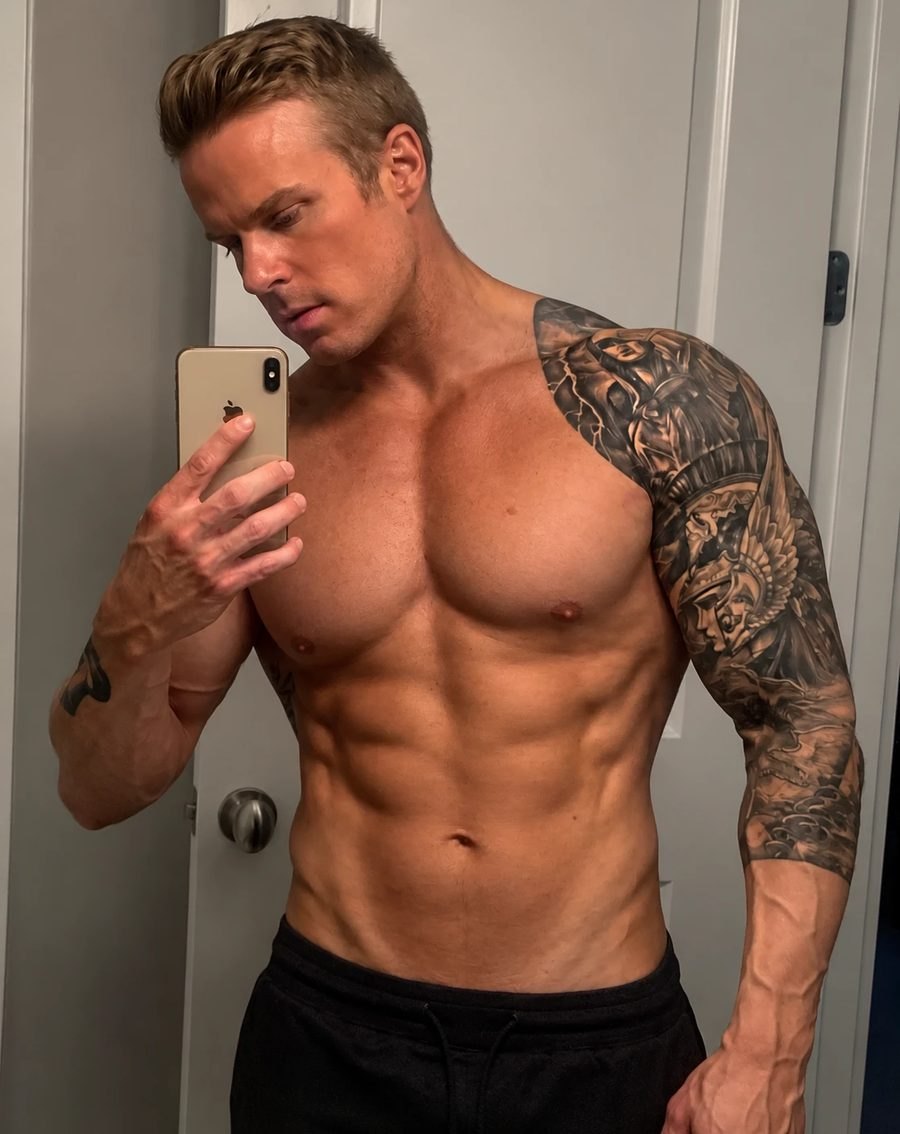
“I’m leaner now, in my forties, than I was in my twenties. I have more energy than I did at thirty. And for the first time in my life, I’m not at war with my own reflection.”Ryan Engel · Founder, Executive Abs
The ideal, in plain terms
| Built for maximum size | The ideal male physique | |
|---|---|---|
| Waist | Often thick, especially when bulking | Narrow and lean, with visible abs |
| Shoulders and back | As big as possible | Broad enough to create the V |
| Muscle | Maximum | Moderate, defined and proportioned |
| Joints and mobility | Heavy loads, more wear | Kind to the back and joints |
| Training | 5–6 sessions a week | 3–4 focused sessions a week |
| Who it impresses | Mostly other bodybuilders | Almost everyone else |
Summary of the research cited in this article.
Pitt’s Achilles, the Doryphoros and the research all point at the same target. You don’t need to be the biggest man in the room. You need to be lean through the middle, strong across the shoulders and back, and proportioned from head to toe. That’s the abs-first physique, and it’s a body you can build and keep for life.
One-to-one coaching built around your calendar, your travel and your starting point. Three to four sessions a week, max. For busy executives, founders and CEOs only.
See the method →References
- CBS News / Associated Press. Pitt kicks butts for Troy role (citing Vanity Fair, June 2004). 4 May 2004. cbsnews.com
- Windy City Times. Manly pursuits: Brad Pitt in Troy. 19 May 2004. windycitytimes.com
- Men’s Health Australia. Brad Pitt’s Troy workout. menshealth.com.au
- Encyclopædia Britannica. Spear Bearer (Doryphoros); Polyclitus. britannica.com/topic/Spear-Bearer; britannica.com/biography/Polyclitus
- Natural History Museum, London. Eugen Sandow: a body worth immortalising. nhm.ac.uk
- Maisey DS, Vale EL, Cornelissen PL, Tovée MJ. Characteristics of male attractiveness for women. Lancet. 1999;353:1500. doi.org/10.1016/S0140-6736(99)00438-9
- Swami V, et al. Male physical attractiveness in Britain and Greece: a cross-cultural study. J Soc Psychol. 2007;147:15–26. doi.org/10.3200/SOCP.147.1.15-26
- Frederick DA, Haselton MG. Why is muscularity sexy? Tests of the fitness indicator hypothesis. Pers Soc Psychol Bull. 2007;33:1167–83. pubmed.ncbi.nlm.nih.gov/17578932
- Pope HG Jr, et al. Body image perception among men in three countries. Am J Psychiatry. 2000;157:1297–1301. doi.org/10.1176/appi.ajp.157.8.1297
- Sell A, Lukaszewski AW, Townsley M. Cues of upper body strength account for most of the variance in men’s bodily attractiveness. Proc R Soc B. 2017;284:20171819. pmc.ncbi.nlm.nih.gov/articles/PMC5745404
- Baggish AL, et al. Cardiovascular toxicity of illicit anabolic-androgenic steroid use. Circulation. 2017;135:1991–2002. pubmed.ncbi.nlm.nih.gov/28533317
- Vecchiato M, et al. Mortality in male bodybuilding athletes. Eur Heart J. 2025;46:3006–16. pubmed.ncbi.nlm.nih.gov/40393525
Ryan Engel’s quotes in this article are from his book, Flip the Fat-Burning Switch.
This article is for general information and is not medical advice. Speak to your doctor before making major changes to diet or training. Observational studies show associations, not proof of cause.